
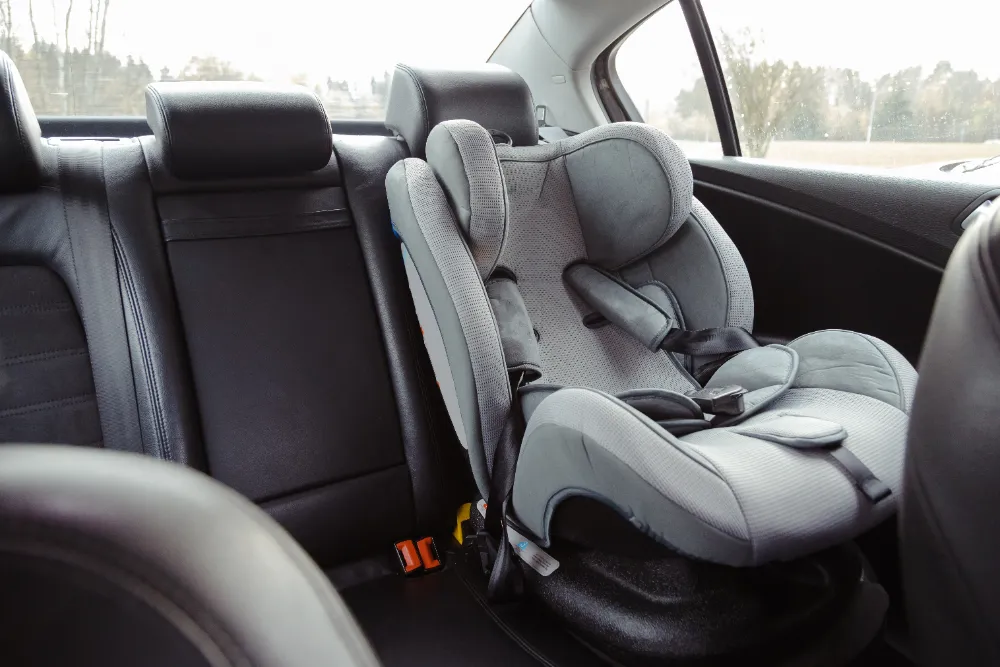
Car crashes remain one of the leading causes of death for children in the United States. In New York, the law takes child passenger safety seriously — and so do we.
Under New York Vehicle and Traffic Law Section 1229-c, every child passenger must be secured in an appropriate child restraint system based on their age, weight, and height. The rules have stages: rear-facing seats for infants, forward-facing seats with a harness for toddlers, booster seats for older children, and then standard seat belts. Getting the stages right and using each seat correctly is both a legal requirement and the single most effective thing you can do to protect your child in a crash.
Properly used car seats reduce the risk of fatal injury by 71% for infants and 54% for toddlers in passenger vehicles, according to the National Highway Traffic Safety Administration. Yet nearly half of all car seats are installed or used incorrectly.
This guide explains exactly what New York law requires at each stage, the penalties for violations, the new 2026 federal safety standards every parent should know about, and what to do if your child is injured in a car accident.
If your child was injured in a car accident, you don’t have to navigate the legal process alone. Speak with a car accident attorney today or Call us at (516) 280-7311 for a free no-obligation consultation and confidential case evaluation.
What Are the Car Seat Laws in New York State
In New York, adhering to the state’s car seat laws and using the appropriate car seat or booster seat for a child’s age, weight, and height is a legal requirement and a crucial step in ensuring their safety during every car journey.
Proper car seat use can save lives and protect children from severe injuries, making it an indispensable safety measure for parents and caregivers.
Child Car Seat Laws in New York
New York State law requires children under age 8 to ride in a federally approved car seat or booster seat that matches the manufacturer’s height and weight limits. Most booster seats require a minimum weight of 40 pounds, but parents must follow the specific manufacturer’s instructions for safe use.
New York State law requires children to use an appropriate child restraint system in motor vehicles until their 8th birthday. As of November 1, 2019, children under 2 must ride in a rear-facing car seat.
Infants Car Seats
In New York State, children must use an appropriate child restraint system in a vehicle until they are 8 years old. New York law requires babies under two to be in a rear-facing car seat. Violations result in fines of $25 to $100.
Toddlers and Young Children
Children under age 4 who weigh over 40 pounds may use a booster seat with an appropriate restraint system. It is essential to choose a seat that is appropriate for their height and weight.
Child Booster Seats
Children who have outgrown their forward-facing car seat but are still too small for the adult seat belt should use a booster seat.
In New York, children under 4 must use a child safety seat. Children under 8 must use a size-appropriate restraint, like a booster seat, until they are 4’9″, 8 years old, or over 100 lbs. Booster seats are for kids 4–8 years old, 40–80 lbs, and under 4’9″, and are used until seat belts fit properly across the chest and thighs.
This requirement continues until they are at least eight years old and meet the height and weight criteria for safe use of an adult seat belt.
Seat Belt
Once a child reaches the age of 8 or exceeds the height and weight requirements for a booster seat, they must use a seat belt. However, it is recommended that all children under the age of 13 ride in the back seat whenever possible.
When children use booster seats, there is a significant reduction in the risk of injury in a car accident.
Booster seats help distribute the force of a crash more evenly across a child’s stronger bones, such as the hips and shoulders, reducing the risk of severe injuries to the neck, spine, and internal organs.
Accordingly, drivers must adhere to New York’s booster seat requirements.
2026 Federal Car Seat Safety Standards: What Parents Need to Know
A significant federal update is taking effect in 2026 that every New York parent should be aware of.
Beginning December 5, 2026, all new car seats and booster seats sold in the United States must meet updated federal side-impact protection standards under FMVSS 213a. These updated standards require seats designed for children under 40 pounds to be tested in a simulated 30 mph side-impact crash a major safety improvement, as previous federal testing only covered front-end collisions.
What this means for parents:
If your current car seat has not expired, you do not need to replace it immediately. However, any new seat purchased after December 5, 2026, must meet the updated standard. If you are unsure whether your seat meets the current standards, contact the manufacturer directly.
The initial FMVSS 213a updates that came into effect in June 2025 also introduced new weight minimums and side-impact testing requirements that influenced manufacturer design recommendations. Many new seats now reflect these updated guidelines in their weight limits.
How Car Seat Laws Affect Your Car Accident Claim
This section connects the informational content to the firm’s practice a connection the existing blog almost entirely misses.
If your child is injured in a car accident in New York, whether they were in a car seat affects your case in two important ways:
If your child was properly restrained and still injured:
You may have a strong claim against the at-fault driver for your child’s injuries, medical bills, pain and suffering, and other damages. The fact that you followed the law and protected your child as required demonstrates responsible conduct and strengthens your position.
If your child was not in a proper car seat:
New York follows comparative negligence rules. If the other driver was at fault for the crash, you can still recover damages but the defense may argue that your failure to restrain your child contributed to the severity of their injuries. This does not automatically bar a claim, but it can complicate it and potentially reduce the compensation you recover.
Recovery is barred if the claimant is found to be more than 50% at fault.
If your child was injured due to a defective car seat:
A separate product liability claim may be available against the car seat manufacturer. Defects such as faulty harness buckles, inadequate crash protection, or flammable materials can give rise to product liability claims independent of any negligence by a driver.
In all of these situations, working with an experienced car accident attorney as quickly as possible after an injury gives your case the best chance of a full recovery.
Frequently Asked Questions
At what age can a child sit in the front seat in New York?
New York law does not set a minimum age for a child to sit in the front seat. However, both the American Academy of Pediatrics and NHTSA recommend that all children under 13 ride in the back seat whenever possible due to the danger posed by front passenger airbags. NYC law references age 12 as a general guideline, but the standard of care is generally age 13. The safest practice is to keep children in the back seat until they are a teenager.
Can my child use only a lap belt without a booster seat?
No. New York law requires children under 8 to use an age-appropriate child restraint system a lap belt alone does not satisfy this requirement. Booster seats must always be used with both a lap and shoulder belt together. A lap belt alone can cause serious abdominal injuries to a child in a crash.
What happens if I buy a used car seat?
Using a used car seat is legal but carries significant risks. You cannot verify the seat’s full crash history, and a seat that has been in a crash may be compromised even if it looks fine. You also may not know if the seat has been recalled. If you do use a second-hand seat, verify that it has not expired, has never been in a crash, includes all original parts and the manual, and has not been subject to a recall.
Do New York car seat laws apply in a rental car?
Yes. New York’s car seat requirements apply to any motor vehicle on New York roads, including rental cars. You are responsible for providing an appropriate car seat for your child. Many rental car companies offer car seats for an additional fee, but you should confirm the seat type is appropriate for your child’s age and size and inspect the installation yourself.
My child is 8 but still small. Do they still need a booster?
The law no longer requires a booster at age 8, but safety experts strongly recommend continuing booster use until the seat belt fits correctly — typically when a child is around 4’9″ tall and can sit with their back flat against the vehicle seat, feet flat on the floor, with the lap belt across the upper thighs and the shoulder belt across the chest. For many children, this is well beyond age 8.
What should I do immediately after a crash involving my child?
First, call 911 and seek medical evaluation for your child even if they appear unharmed some injuries are not immediately apparent. Document the scene with photographs. Get the police report number. Do not move your child’s car seat from the vehicle until photographs are taken, as its position and condition can be important evidence. Contact a car accident attorney before speaking with any insurance company.
Has Your Child Been Injured in a NY Car Accident?
You may be entitled to financial compensation to cover the costs of your child’s injuries if they were recently injured in a motor vehicle collision in New York, regardless of whether they were in a car seat.
At the Law Offices of Theodore A. Naima, our New York personal injury lawyer has nearly three decades of experience aggressively pursuing damages awards for accident victims and their loved ones.
Call the Law Offices of Theodore A. Naima to learn more and to schedule a free consultation today. You can also connect with us through our online contact form.

Theodore A. Naima
Theodore “Ted” Naima is a personal injury and medical malpractice attorney licensed in New York and Florida. He earned his Finance degree from Syracuse University and his law degree from the University of Miami. With decades of litigation experience, Ted has represented injury victims and families in complex personal injury, wrongful death, and medical malpractice cases since 1997. He founded the Law Offices of Theodore A. Naima in 2010 and was awarded the AV Preeminent® rating by Martindale-Hubbell®. His $9 million verdict in Ramos v. Bartis was recognized by the New York Law Journal Verdict Hall of Fame as one of the top verdicts in New York State.
