

One of the biggest stressors associated with filing a personal injury lawsuit is not having a firm grasp of the process.
By better understanding how cases proceed through the system, much of the stress and anxiety of being embroiled in a lawsuit can be reduced.
Read on to learn more about what happens after a deposition.
What Is a Deposition?
A deposition is a recorded interview conducted during the discovery phase of a personal injury trial.
During a deposition for a personal injury case, one or both sides prepare a list of questions to ask the witness.
An attorney will ask the witness questions while a court reporter takes down both the questions and the answers.
And while your attorney will be at your side throughout the deposition, it is still wise to prepare for the questions that may be asked.
What Comes After a Deposition?
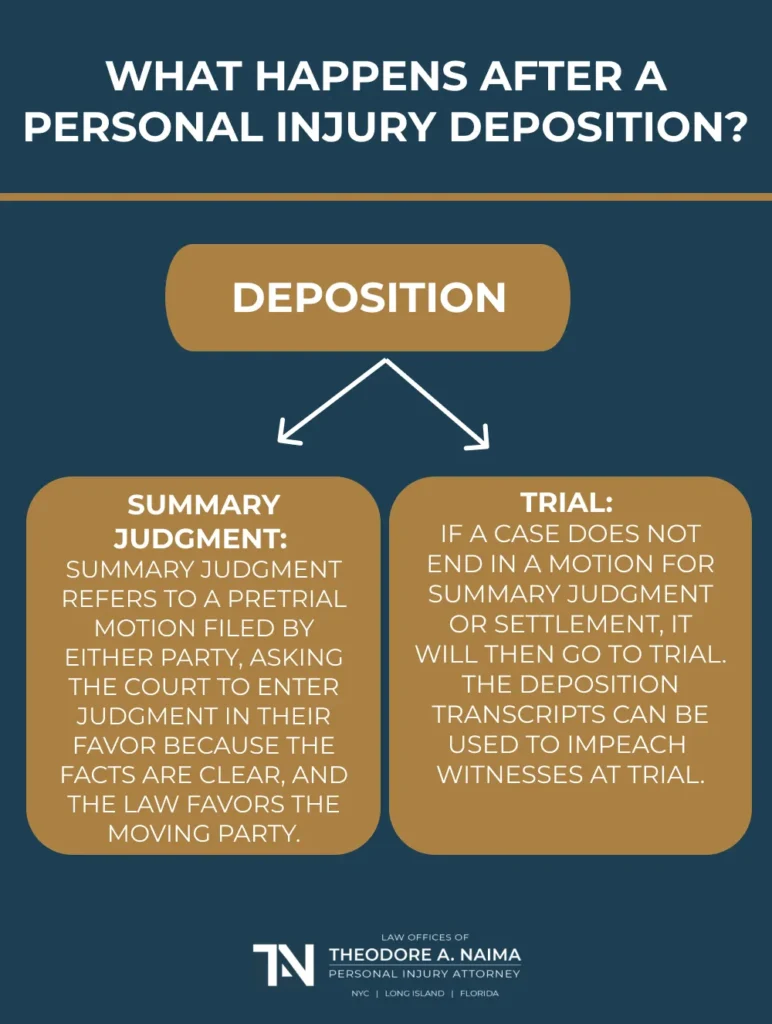
What happens after deposition in a personal injury case depends on how the deposition went and each side’s willingness to settle.
Once the deposition is complete, each side gets a transcript of the interview to review.
Depending on what the witness said, the information contained in a deposition will inform and guide subsequent settlement discussions.
For example, suppose an accident victim’s deposition is completely in line with the police report and clearly makes a case against the other driver.
In that case, an insurance company may consider offering a pretrial settlement to avoid trial.
However, if an accident victim’s testimony is inconsistent or appears exaggerated, the insurance company may decide to take its chances at trial and forego attempting to settle the case.
Summary Judgment
If a case does not settle, the next stage of the process is summary judgment.
Summary judgment refers to a pretrial motion filed by either party, asking the court to enter judgment in their favor because the facts are clear, and the law favors the moving party.
Many personal injury cases resolve at the summary judgment stage and those that do not often settle shortly afterward.
Trial
If a case does not end in a motion for summary judgment or settlement, it will then go to trial.
The deposition transcripts can be used to impeach witnesses at trial.
For example, if a witness answers a question one way at the deposition and then provides a different answer at trial, the opposing lawyer can bring up this inconsistency.
Minor inconsistencies are expected, as jurors generally understand that no one’s memory is perfect.
But inconsistent testimony regarding a material issue of the case may lead the jury to conclude that the witness is either mistaken or lying.
Either way, it lessens the witness’s credibility and taints their testimony if they contradict themselves regarding a material issue.
The information provided on this page speaks in general terms.
Of course, there are often exceptions that apply in certain situations. For a complete list of all exceptions, please consult the Consolidated Laws of New York.
Attorney Naima is also happy to answer any questions you have about your injuries or ability to pursue a claim against the responsible party.
Did You Suffer Injuries in a New York Accident?
If you or a loved one was recently involved in an accident and are considering a personal injury lawsuit, reach out to the Law Offices of Theodore A. Naima.
Attorney Naima is a respected New York personal injury attorney with more than 25 years of hands-on experience handling a wide range of cases, including car accidents, motorcycle wrecks, truck collisions, slips and falls, and more.
He provides a unique form of client-centered representation designed to secure the best possible outcome for his clients.
To learn more and to schedule a free consultation, call 516-280-7311 today. You can also reach us through our online contact form.

Theodore A. Naima
Theodore “Ted” Naima is a personal injury and medical malpractice attorney licensed in New York and Florida. He earned his Finance degree from Syracuse University and his law degree from the University of Miami. With decades of litigation experience, Ted has represented injury victims and families in complex personal injury, wrongful death, and medical malpractice cases since 1997. He founded the Law Offices of Theodore A. Naima in 2010 and was awarded the AV Preeminent® rating by Martindale-Hubbell®. His $9 million verdict in Ramos v. Bartis was recognized by the New York Law Journal Verdict Hall of Fame as one of the top verdicts in New York State.
Rate this Post


 Loading...